Social platforms are the best discovery engine ever built. Every day they put your work in front of people who have never heard of you, for free, and for most creators that is exactly where it all starts.
The natural next step is giving those people somewhere of your own to land: an address with your name on it, an app on their home screen, and a list you can write to directly. Discovery brings people in. Ownership is what turns them into a business.
Discovery over there, home base over here
These are two different jobs, and everything gets easier when each one does what it's best at. Social platforms are brilliant at introductions. A home base of your own is where the relationship settles in:
- Discovery — the feed keeps finding new people for you, at a scale nothing else matches.
- Trust — an address with your own name on it is where those people decide you're a real business.
- Continuity — your app and your customer list are how they come back without having to look for you first.
- Compounding — everything you publish on your own domain keeps working for you, year after year.
Keep posting exactly as much as you do now. All that changes is where people land when they're ready to buy.
Where each part of your world does its best work
Owning the second half takes nothing away from the first. It gives every moment somewhere to go next.
| The moment | Where social shines | What owning it adds |
|---|---|---|
| Someone finds you for the first time | Reach you couldn't buy — the feed does the introducing | They land on a page with your name on it |
| A customer wants to come back | A quick search brings up your profile | Your app is already on their home screen |
| You have something to tell everyone | A post reaches whoever is scrolling today | An email reaches everyone who has bought from you |
| Someone searches your name | Your profile comes up straight away | So does your own domain, building on itself year after year |
| You launch something new | The feed builds the anticipation beautifully | Your own storefront takes the orders |
| Someone decides to buy | The interest starts there | The payment lands in your own Stripe account |
None of this asks you to post less. It just gives the people who are ready somewhere solid to go.
Your own domain takes about fifteen minutes
Start with the address, because everything else hangs off it. A WithMe hub can be served from a domain you own — yourname.com, with your name as the whole of it.
From that point on, everything you publish accrues to a name you control. The link in your bio, the pages people bookmark, the reputation a domain quietly builds in search over a few years — all of it attaches to you.
It's also the piece that rewards starting early. A domain builds its standing in search gently, over years, so the sooner your name is the one collecting it, the more it's worth by the time you really need it.
Your app, on their home screen
The second place your audience lives is their phone, and a home-screen icon is about as close to your customers as you can get.
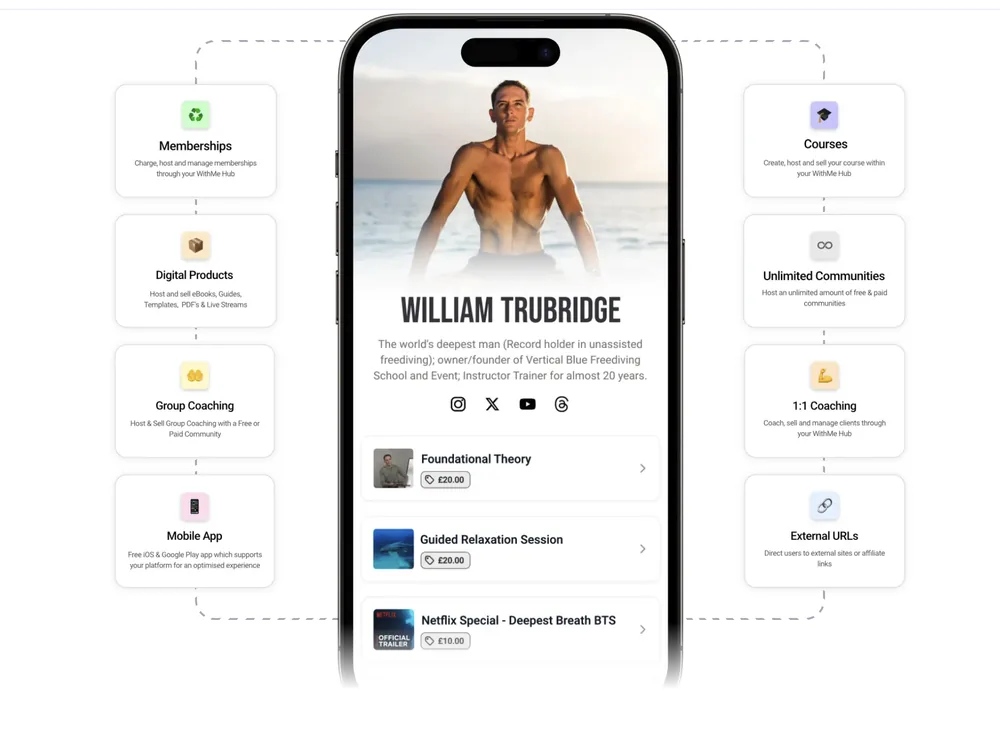
Every WithMe hub comes with iOS and Android customer apps as standard. The people who buy from you download an app, sign in, and find their courses, coaching, community and downloads waiting for them in one place.
White-label: your name on the App Store
Standard apps are a great default. The fullest version of owning your audience is a white-label app: your own listing in the App Store and on Google Play, under your name and your icon, branded as yours from the first screen to the last.
We build it, submit it and keep it updated under our developer account. You do the part you were always going to do — the content, the branding, the customers.
Real examples, live in the App Store
These aren't mockups. The apps below are built on WithMe and are in the App Store today, and the quickest way to understand white-label is to see how completely each one belongs to its creator.

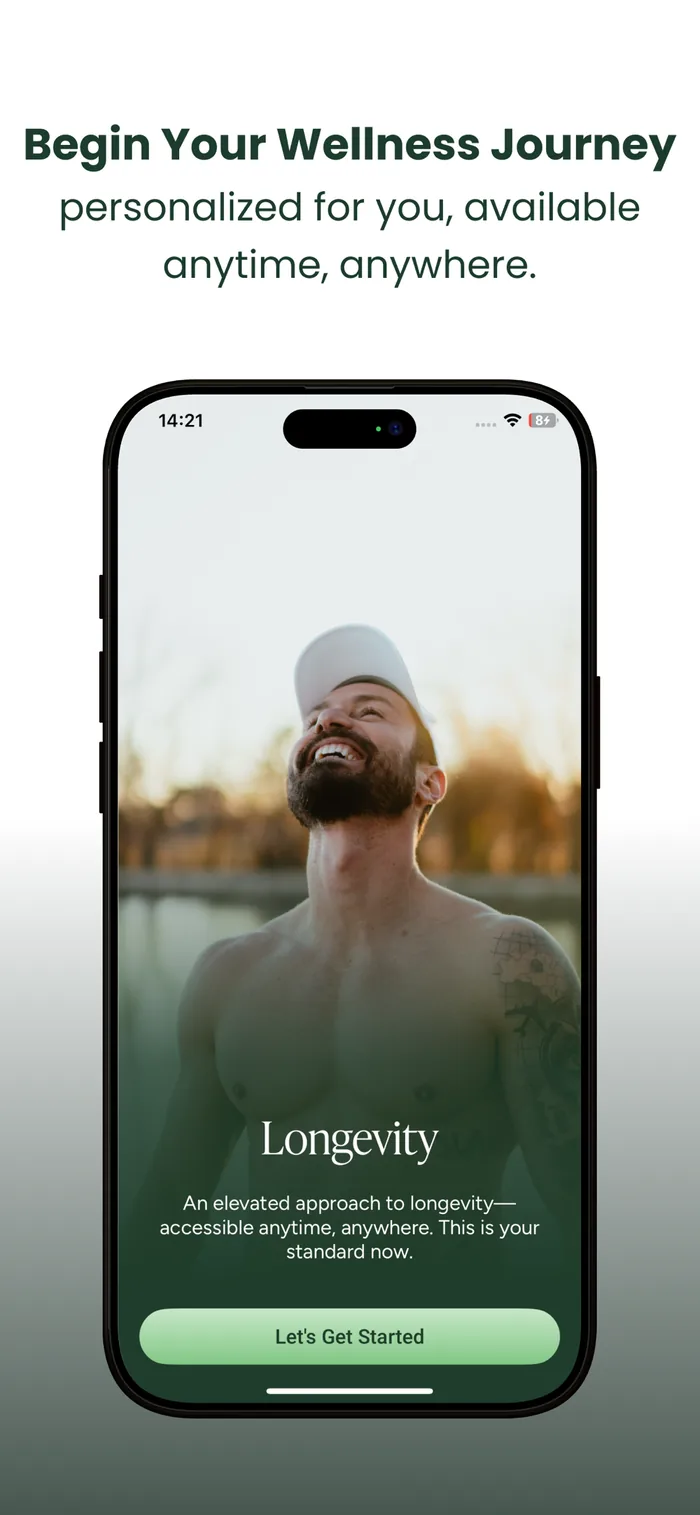

One is cream and serif and unmistakably Pocket Pilates. Another is deep green wellness and unmistakably Denis Blanco. Someone downloading either is downloading that creator's app, with their brand front and centre the whole way through.
Why a white-label app is such a strong move
A domain wins you the browser. An app wins you the phone — and the phone is where your customers already are. Your icon sits on the home screen alongside the apps they open every day, one tap from everything you've made.
It changes how you look, too. An app in the App Store under your own name is credibility you can point at: it tells people this is a business they can download, with everything you offer in one place.
A home-screen icon is attention that stays with you between posts. The people who love your work can reach all of it the moment they think of you.
The list is the asset that compounds
Almost every creator who has been at this a while says the same thing: start collecting email addresses early. A customer list is the part of an audience that stays with you through everything else you do.
Everyone who buys from you on WithMe becomes a customer record in your hub — who they are, what they bought, when they bought it — and you can email all of them from that same place, as often as you like.
All of it belongs to you
The domain stays in your name and you remain the registrant throughout. Your customer list lives in your hub. Payments run through your own Stripe account, with the full history attached to it. Every piece of this is registered to you and stays that way.
That's what owning an audience means in practice: the relationship is yours, and it travels with you.
Keep posting, keep growing the follower count, and make the most of how good social is at introductions. Then give the people who are ready somewhere of your own to land: your domain, your app, your list.